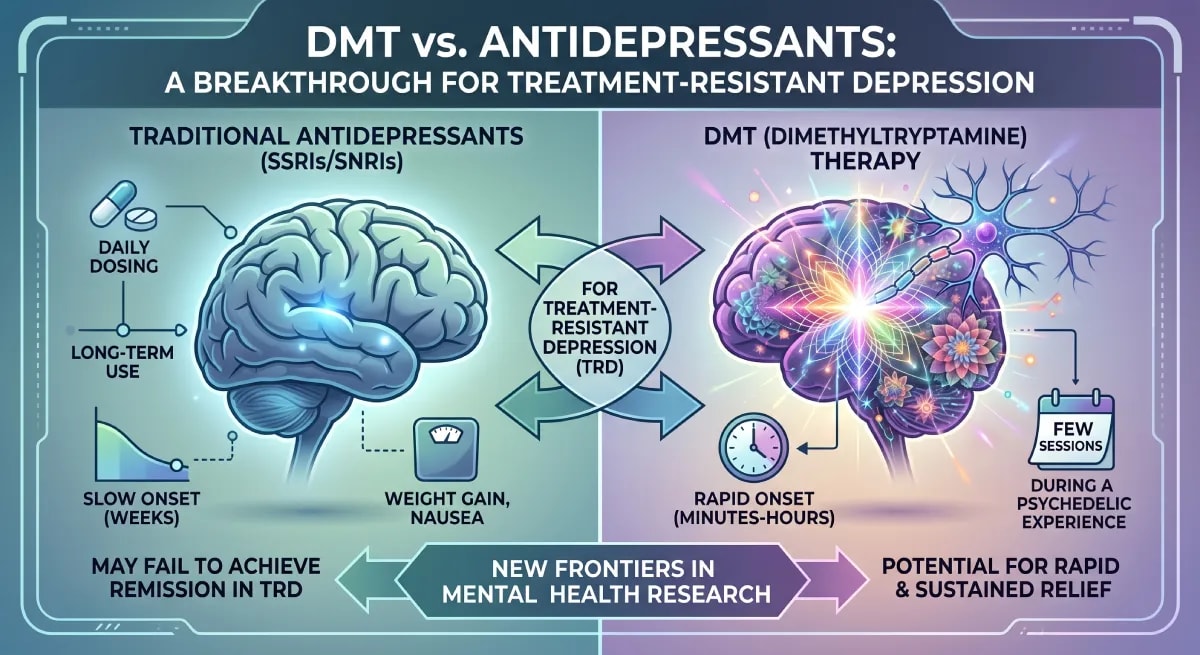
For many young adults navigating the labyrinth of modern psychiatry, the promise of "recovery" often feels like a receding horizon. When the standard medical toolkit—the SSRIs, the SNRIs, the talk therapy—exhausts its options, the silence that follows is more than just frustrating; it’s life-threatening. This is the reality of treatment-resistant depression (TRD), clinically defined as a failure to respond to at least two standard antidepressant interventions. For this demographic, usually in their vibrant early 30s, the "daily pill" model hasn't just failed; it has become a reminder of their own perceived brokenness.
However, a landmark study recently published in the prestigious journal Nature Medicine suggests we may be standing on the precipice of a seismic shift in our intervention toolkit. The research focuses on N,N-Dimethyltryptamine (DMT), a potent psychedelic compound that has long lived in the shadows of its slower-moving cousins, psilocybin and LSD.
Dr. Misha Kogan, a leading voice in integrative medicine, describes this data as a potential "paradigm shift." We are moving away from the "maintenance" model of mental health and toward rapid-acting, high-intensity interventions that aim to rewrite neural pathways in a fraction of the time required by traditional pharmacology.
Takeaway 1: A Magnitude of Change "Standard" Meds Can’t Touch
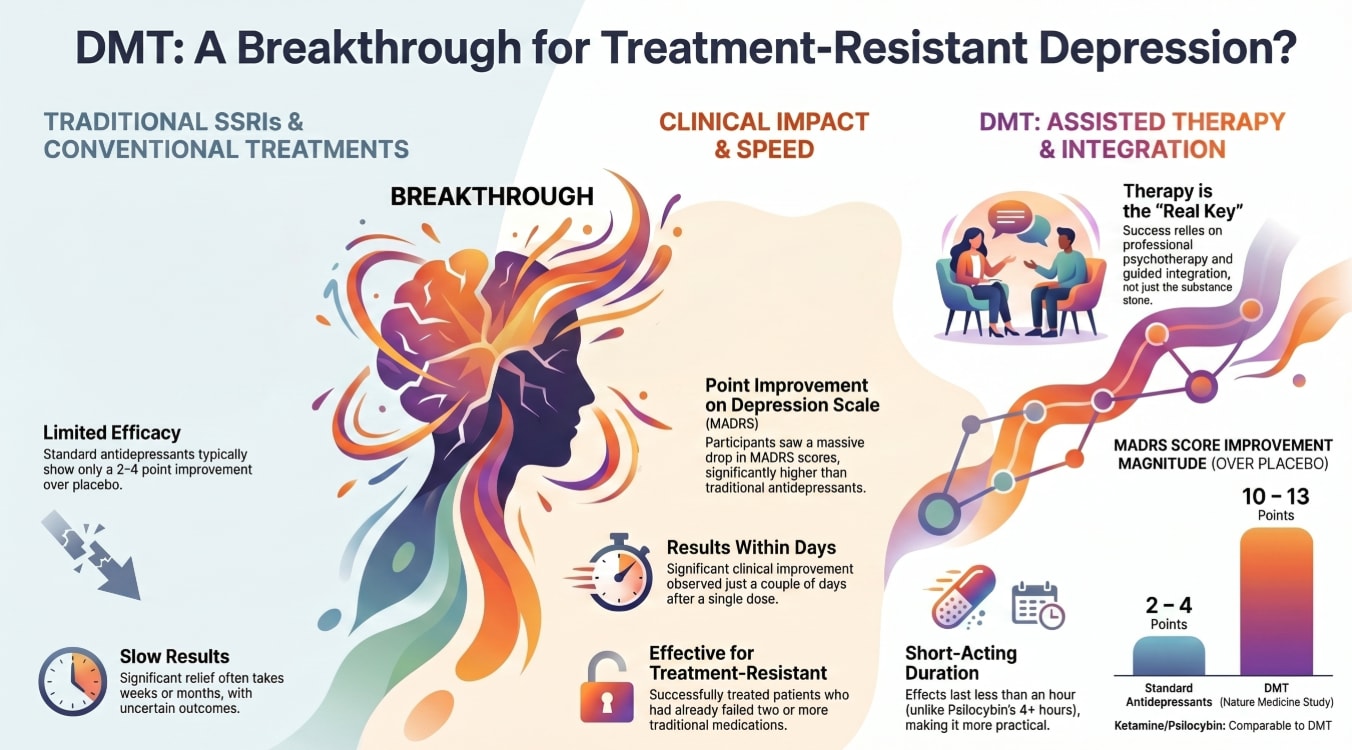
To quantify the efficacy of this breakthrough, researchers utilized the Montgomery-Åsberg Depression Rating Scale (MADRS), a sophisticated clinical tool that gauges the severity of depressive episodes. While the study was a small pilot group consisting of approximately 34 participants, the results were statistically staggering. Patients receiving the DMT intervention demonstrated a peak improvement of 13 points on the MADRS scale.
To appreciate the gravity of that number, consider the benchmarks of the pharmaceutical industry: in typical antidepressant trials, a new drug often only shows a 2-to-4 point improvement over a placebo. While a first-time medication user might see a 14-point drop, these participants were individuals who had already hit a therapeutic ceiling with every other drug on the market. Adding a 13-point gain to a population that has "tried everything" is a clinical feat nearly unheard of in conventional psychiatry.
"There is not a single anti-depressant drug that can do that. They just they don't exist."
Even at the three-month mark, patients maintained a significant 8-point improvement, effectively migrating from "moderate-to-severe" depression into the "mild" range. This size-effect suggests that DMT can reach the biological "reset button" in ways standard molecules simply cannot.
Takeaway 2: Efficiency is the New "Gold Standard" (DMT vs. Psilocybin and Ketamine)
In the emerging "psychedelic renaissance," psilocybin and ketamine have been the standard-bearers. However, they carry a heavy burden of medical economics. A therapeutic psilocybin session is labor-intense, often requiring four to six hours of clinical supervision and, in many cases, multiple doses. Ketamine, while effective, frequently demands a grueling schedule of 10 or more infusions to maintain its antidepressant effect.
From a practical perspective, DMT is the "efficient" disruptor. A DMT session is remarkably brief, typically concluding in under an hour. For a healthcare system buckling under the weight of a mental health crisis, this is a game-changer. Shorter sessions mean higher patient throughput and lower costs without sacrificing the "size-effect" of the treatment. For the patient, it offers a profound "trip" that fits into a lunch hour, making high-level psychedelic therapy accessible rather than an all-day ordeal.
Takeaway 3: The Secret Ingredient Isn't Just the Molecule—It’s the Therapy
As an integrative health journalist, I must emphasize that the "power" here isn't just a chemical reaction in the synapse. Dr. Kogan is clear: the substance is the catalyst, but the clinical container is the cure. This study was not a "get a shot and get out" model—a common criticism of some high-volume ketamine clinics. Instead, it was a strict therapy administered with a lot of guiding.
The efficacy of DMT relies on the "right setup, right settings, and the right person." The molecule creates a temporary, highly plastic altered state of consciousness, which serves as a fertile ground for intensive psychotherapy. In this clinical model, the therapist acts as a navigator through the patient's internal landscape. Without this professional guidance, the "trip" is just an experience; with it, the experience becomes a structured biological and psychological healing process.
"I do think that the power here doesn't come from the substance alone. The power here comes from an altered state of consciousness where the therapy—the psychotherapy—is delivered in the right way."
Takeaway 4: Short Duration, High Intensity (A Warning Against DIY)
There is a dangerous paradox in DMT: because it is shorter, it is often significantly more intense than other psychedelics. While psilocybin is a long, slow climb, DMT is a vertical takeoff. This compressed intensity carries a substantial psychological weight and a high risk of an existential crisis.
While physical side effects in the study were mild—limited to nausea, anxiety, and injection-site pain—the potential for psychological distress is profound. This is why Dr. Kogan and other experts explicitly warn against attempting to use inhaled versions recreationally. Without a trained clinician to help "land the plane," the depth of a DMT experience can be terrifying rather than transformative. The "clinical container" isn't just for comfort; it is a safety requirement for a substance that can temporarily dissolve one's sense of self.
The Future of Psychedelic Medicine: A Final Thought
The Nature Medicine study is a lighthouse for the future of integrative medicine, but we are still in the early hours of this new dawn. To move DMT into the mainstream, we require larger trials and data on older populations to ensure that the cardiovascular and psychological intensity is safe for all ages.
As we look toward a future where "one-dose" intensive interventions outperform thirty years of daily pill-taking, we have to ask a difficult question: Is our current mental health system, built on the "maintenance" of symptoms, becoming obsolete? If we can achieve in an hour what we previously couldn't achieve in a decade, the very definition of "healing" is about to change forever.